
PPLN (Periodically Poled Lithium Niobate)
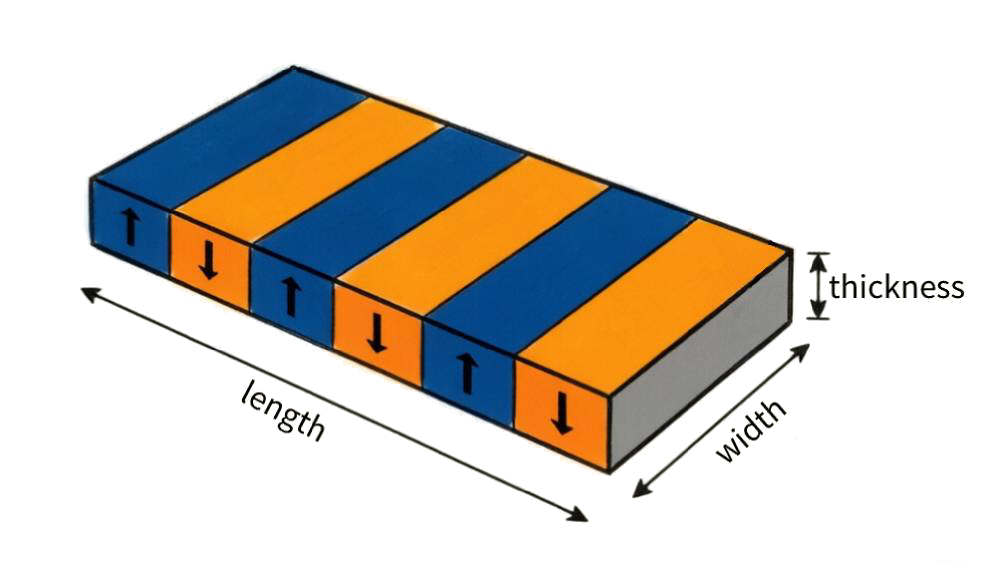
PPLN is a highly efficient nonlinear optical crystal based on the core principle of Quasi-Phase Matching (QPM). By periodically reversing the polarization direction within the crystal, it effectively compensates for phase mismatches, significantly boosting the efficiency of laser wavelength conversion.
Main Categories
- Bulk PPLN: Ideal for standard free-space optical setups, widely used in high-power laser systems.
- Waveguide PPLN: Confines light within micro-scale channels, offering ultra-high conversion efficiency and easy integration with optical fibers.
- Doped PPLN: Enhanced with Magnesium Oxide (MgO) to significantly improve resistance to optical damage, making it perfect for high-power applications and stable room-temperature operation.
Technical Specifications
Type
SHG/OPO, etc.
Grating Type
Single/Multi/Chirp/Fan-out/Cascade, etc.
QPM Period
4.0μm ~ 200μm
Wavelength Range
330nm ~ 5.5μm
QPM Temperature
25°C ~ 200°C
Flatness
λ/6 @ 633nm
Parallelism
< 10"
Perpendicularity
< 10'
Surface Quality
10-5
Coating
Anti-Reflection (AR) or High-Reflection (HR)
| Pro Name | Specs | Price |
|---|---|---|
| Single-Period PPLN Crystal Chips |
View Specs
|
Single-Period PPLN Crystal Chips
Basic Structure
- QPM Period: 4.0µm ~ 200µm
- Wavelength Range: 330nm ~ 5.5μm
- QPM Temperature: 25℃– 200℃
- Flatness: λ/6 @ 633 nm
- Coating: Anti-Reflection(AR)/High-Reflection(HR)/Filter coatings available on input/output facets.
- Material Options: Standard Lithium Niobate (LN) /Magnesium Oxide (MgO) doped Lithium Niobate.
Nd:YVO4 + PPLN Optically Contacted Bonded Chips Introduction
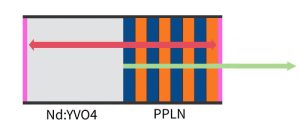
This composite chip integrates a laser gain medium with a nonlinear crystal for a compact, integrated optical engine.
- Nd:YVO4 (Front End): As the laser gain medium, it absorbs external pump light (typically from an 808 nm laser diode) and generates fundamental infrared laser light at 1064 nm. Nd:YVO4 is chosen for its high absorption and conversion efficiency, as well as its linearly polarized output, making it an excellent core for compact lasers.
- Optical Contacting Interface: The two crystals are bonded via atomic-level molecular forces without any air gaps or chemical adhesives. This ensures the 1064 nm laser passes from the Nd:YVO4 into the PPLN with virtually no reflection or scattering loss.
- PPLN (Rear End): Acting as the nonlinear optical crystal, it receives the 1064 nm infrared laser and efficiently converts it into other wavelengths (e.g., frequency doubling to 532 nm green light, or other wavelengths via OPO/DFG).
Selected Typical Products
| Product Type | Application | QPM Period | Optional Thickness |
|---|---|---|---|
| S-1064-SHG | 1064nm SHG | 6.97 µm | 0.5, 1, 2, 3 mm |
| S-1550-SHG | 1550nm SHG | 19.60 µm | 0.5, 1, 2, 3 mm |
| S-1580-SHG | 1580nm SHG | 20.22 µm | 0.5, 1, 2, 3 mm |
| S-I-1064-SHG | NdYVO4+PPLN 1064nm SHG | 6.97 µm | 0.5, 1, 2, 3 mm |
Typical Application Scenarios
1. 1064 nm SHG (Green Light Generation)
- Chip Specs: MgO:PPLN substrate, QPM period 6.97 µm.
- Dimensions: 2.0 (W) × 1.0 (T) × 1.2 (L) mm.
2. 1550 nm SHG (Telecom Band Conversion)
- Chip Specs: MgO:PPLN substrate, QPM period 19.6 µm.
- Dimensions: 1.5 (W) × 1.0 (T) × 50 (L) mm.
3. 808 nm Pumped Green Laser (All-in-One Module)
- Chip Specs: Nd:YVO4 + PPLN bonded crystal, QPM period 6.97 µm.
- Dimensions: 2.0 (W) × 2.0 (T) × 3.3 (L) mm.